
Difficulty Adjustment Explained for Miners Who Just Want the Numbers
Bitcoin's difficulty exists for one purpose: to hold the average gap between blocks near ten minutes no matter how much hashrate joins the network. Today that target sits at 132.76 T, with the next adjustment estimated at roughly −2.12% at the time the data was read. The practical consequence for a miner is easy to state: network issuance is a fixed 450 BTC per day, so a 2.12% difficulty drop adds about 2.2% to what the same hardware earns while price stands still.
Key takeaways
- 450 BTC per day of network issuance divided by roughly 1,003 EH/s of network hashrate works out to about $0.038 per TH/s per day at a BTC price of $84,692.
- A 2.12% difficulty decrease raises expected output per unit of hashrate by about 2.2%; an increase of the same size cuts it by about 2.1%.
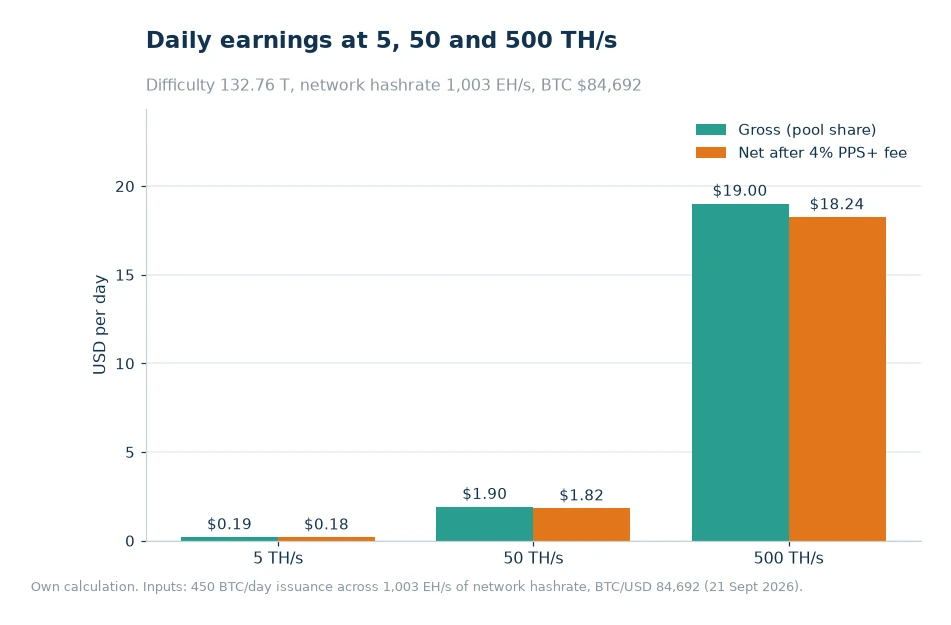
- 500 TH/s currently grosses about $19.00 per day, and about $18.24 after the listed 4% fee on the PPS-settled block-reward component.
- Pools change fees, variance and payout cadence. They do not change your share of network hashrate, which is the ceiling on everything else.
The short answer
Difficulty is a number that says how many hashes a miner is expected to perform, on average, to find one block. At 132.76 T the network expects roughly 132.76 trillion hashes per block found. Raise that number and every individual hash is worth less; lower it and every hash is worth more.
Because the protocol pays a fixed subsidy of 3.125 BTC per block and targets 144 blocks per day, the total pie stays at 450 BTC daily — about $38.1 million at $84,692 per BTC — and your slice is your share of total hashrate. That is the whole model. Everything a miner argues about, from firmware to firmware-level overclocking to pool choice, is either a cost adjustment or a variance adjustment around that fixed share.
How the mechanism works
The protocol re-measures the network every 2,016 blocks and rescales difficulty so that the recent average block interval lands back on ten minutes. If hashrate grew faster than expected, difficulty rises; if hashrate fell, difficulty falls. Nothing about your machine enters the calculation except through the total it contributes to.
So the arithmetic a miner actually needs is one line long:
your hashrate ÷ network hashrate × 450 BTC × (1 − fee) = daily output
Work at current numbers and the per-unit revenue falls out immediately. A single terahash earns 4.49 × 10⁻⁷ BTC per day, which is $0.038 at $84,692. Multiply by your own capacity and the fee question becomes concrete rather than rhetorical: ViaBTC lists 4% on the PPS-settled block-reward component under PPS+ and 2% on the PPLNS-distributed components.[1]
| Hashrate | Gross BTC/day | Gross USD/day | Net after listed 4% | Gross USD/day after −2.12% |
|---|---|---|---|---|
| 5 TH/s | 0.00000224 | $0.19 | $0.18 | $0.19 |
| 50 TH/s | 0.00002243 | $1.90 | $1.82 | $1.94 |
| 500 TH/s | 0.00022430 | $19.00 | $18.24 | $19.41 |
Read the table column by column before reading it row by row. The gap between gross and net is the fee; the gap between the third and fifth columns is difficulty. Only the second one is outside your control, and it moves a few percent at a time rather than doubling or halving.
Where miners get it wrong
Mistake one: reading PPS+ as a flat 6% haircut. The 4% applies to the block-reward component settled per share, while the 2% applies to the transaction-fee component, which is usually the smaller slice of the total. ViaBTC's own fee breakdown exists largely to correct that conflation, because a 4% charge on one component and a 6% charge on everything are different numbers.[2]
Mistake two: treating difficulty as a forecast. Difficulty follows hashrate with a lag, so it confirms what other miners already did rather than anticipating what they will do. The estimate of −2.12% read on 21 September 2026 says something about the last two weeks of competition, not about the next two.
Mistake three: assuming pool size changes expected value. A larger pool reduces the variance of your payout, because more blocks are found and the law of large numbers does more of the work. It does not raise your expected earnings, and in some jurisdictions it concentrates hashrate in a way miners prefer to avoid. What actually differs between pools is fee structure, uptime, latency and payout cadence.
That last point is where the details live. PPS+ settles per share against current difficulty on an hourly cycle; PPLNS distributions follow the blocks a pool finds and are weighted by each miner's share of pool hashrate across the most recent five difficulty rounds. One buys predictability, the other asks you to absorb the swings.
A checklist you can run today
- Recompute your own ceiling. Take your total valid hashrate, divide by 1,003 EH/s, multiply by 450 BTC, then apply the fee that applies to each component. If the result surprises you, the surprise is the fee structure, not the network.
- Note the current adjustment estimate. A 2.12% change on a 50 TH/s machine is worth about $0.03 per day — small, but reapplied every retarget it is the difference between two hardware cycles.
- Check electricity against revenue, not against hope. At $0.06 per kWh, 10 PH/s of 20 J/TH hardware draws 200 kW, or 4,800 kWh a day and about $288 of power, against roughly $380 a day of gross income at current difficulty. That margin is thin enough that efficiency matters more than headline hashrate.
- Run the numbers before buying anything. A profit calculator that takes coin price, difficulty, fee rate and effective hashrate is faster than a spreadsheet, and it is the only honest way to compare two machines.
- Confirm where the coins land. A pool account with an integrated multi-currency wallet and zero-fee mining payouts removes transfer steps that quietly cost more than a tenth of a percent of fee.
Worked example: 500 TH/s across one adjustment
Take 500 TH/s of effective hashrate, which is a mid-sized farm or four modern machines. At a network hashrate of 1,003 EH/s it holds 4.98 × 10⁻⁷ of the network, producing 0.00022430 BTC per day, or $19.00 gross. Apply the listed 4% fee on the block-reward component and roughly $18.24 reaches the account.
Now let the estimated −2.12% adjustment land. The same 500 TH/s now represents a slightly larger share of a slightly smaller network and produces 0.00022916 BTC per day, which is $19.41 gross. Over the interval between retargets that is about $0.41 a day, or $5.74 across the period, from a change no one had to buy hardware for. That is how difficulty shows up on a miner's statement: never as a headline catastrophe, always as a modest line that compounds in whichever direction the network is moving.
This is also why operating history matters more than any single week of numbers. A pool that has kept paying across several difficulty regimes is making a different kind of statement than a dashboard showing a good month. Operators who want that history in one place can look at the ViaBTC Mining Pool, which reports serving miners in more than 150 countries with over a million users and covers 20+ coins, including BTC, BCH, LTC/DOGE merged mining and KAS — breadth that matters when one chain briefly becomes unattractive to hash.
Frequently asked questions
What happens if my miner goes offline?
Shares stop, so expected income stops with them. Alerts and a dashboard that shows per-worker hashrate shorten the gap between a failure and a fix.
Is a bigger pool always better?
Size reduces payout variance but also concentrates hashrate. What matters more is fee structure, uptime, latency and payout cadence.
Can difficulty fall as well as rise?
Yes. Difficulty is recalculated from observed block intervals, so a period in which network hashrate fell produces a downward adjustment. The estimate read on 21 September 2026 was a 2.12% decrease.
Recheck the arithmetic, not the narrative
Difficulty is the least dramatic variable in mining and the one that quietly decides who survives a hardware cycle. Put the formula in a note, run it whenever an adjustment lands, and compare the result against your electricity bill rather than against last quarter's screenshot. If the number still clears, keep hashing; if it does not, the answer is efficiency or price, not a different dashboard.
Data and sources: network difficulty (132.76 T), network hashrate and the next adjustment estimate were read from public chain data on 21 September 2026. Fee components and settlement rules come from the published fee schedule[1] and the ViaBTC fee breakdown[2]. BTC price $84,692. Figures are own calculations, rounded, and change with difficulty and price.